
Original report · translated from Chinese
Post-holiday weight concerns? The emerging GLP-1 medicine efsubaglutide alfa reports positive Phase II weight-loss progress.
After Lunar New Year and Valentine's Day celebrations, many people find themselves concerned about weight gain. There is encouraging news in weight-loss research: the emerging GLP-1 medicine efsubaglutide alfa has reached another milestone. Innogen announced notable results from a Phase IIa weight-loss study of its independently developed Efsubaglutide Alfa Injection.
Study design
The Phase IIa study of efsubaglutide alfa was a multicenter, randomized, double-blind, placebo-controlled clinical trial led by Professor Weiping Jia, an academician of the Chinese Academy of Engineering at Shanghai Sixth People's Hospital, affiliated with Shanghai Jiao Tong University School of Medicine. It evaluated tolerability, safety and weight-loss effects in patients with overweight or obesity inadequately controlled by dietary and exercise interventions. Participants were assigned to different doses of efsubaglutide alfa or placebo. Doses were increased every two weeks until the target dose was reached, then maintained for four weeks. The primary efficacy endpoints were percentage change in body weight from baseline and the proportion of participants achieving at least 5% weight loss.
Body-composition and weight-loss results in the later paper
The 2026 LIGHT 1 paper reports decreases in both fat mass and lean mass, alongside an improved lean-to-fat mass ratio. That improved ratio does not show that muscle mass remained unchanged, as the earlier headline may suggest.
The later paper reports that 82.5% of efsubaglutide-treated participants lost at least 5% of body weight. This earlier announcement gave a figure of 84.6%. The abstract does not explain why the reported figures differ.
Significant weight reduction with maintenance of muscle mass
The study enrolled 50 patients with overweight or obesity. Their mean age was 36 years, mean BMI 33 kg/m² and mean body weight 92.9 kg. After four weeks at the target dose, the mean percentage change from baseline in the efsubaglutide alfa group was −7.2% (approximately 6.5 kg), compared with −0.9% (approximately 0.5 kg) in the placebo group. In addition, 84.6% of patients receiving efsubaglutide alfa lost at least 5% of their body weight, while none receiving placebo reached that threshold. The 10 mg and 20 mg groups showed particularly strong weight loss, with mean changes of −7.7 kg and −8.6 kg, respectively. Efsubaglutide alfa also substantially reduced waist circumference, by up to 6.9 cm. Reduced fat mass generally accompanies lower blood lipids and blood pressure. A continued downward trend in body weight was also observed in the efsubaglutide alfa group.
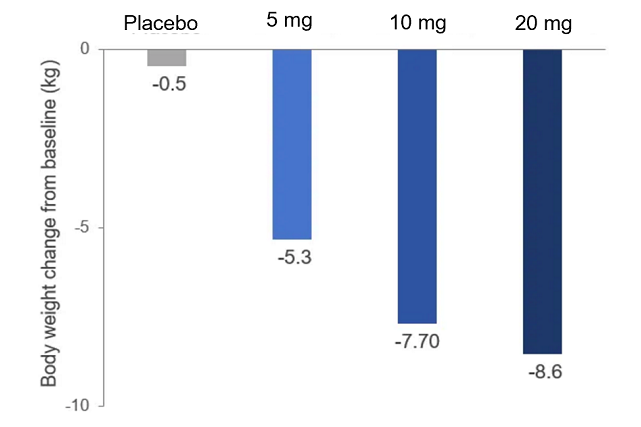
Image text and data — Phase IIa figure: change in body weight from baseline
The vertical axis shows body-weight change from baseline in kilograms. The bars are labelled: placebo −0.5 kg; efsubaglutide alfa 5 mg, −5.3 kg; 10 mg, −7.70 kg; and 20 mg, −8.6 kg. No error bars are shown.
The figure accompanies the Phase IIa study described in the article, in which doses were titrated and then maintained at the target dose for four weeks. It does not show a single-dose result or an approved weight-loss regimen.
Efsubaglutide alfa also significantly reduced fat mass in this study, with a mean reduction of 4.5 kg (13.1%), while the muscle-to-fat ratio—the ratio of muscle mass to total body fat—increased by 19.7%. The corresponding fat-mass and muscle-to-fat-ratio figures in the placebo group were 0.2 kg (1.2%) and 0.97%.
Good safety with few adverse reactions
Efsubaglutide alfa showed good safety and tolerability in the study. The most common adverse events were mild-to-moderate gastrointestinal symptoms, including nausea, vomiting and diarrhea. These were mostly transient. No serious adverse events or hypoglycemia occurred, and no participant withdrew because of an adverse event.
How efsubaglutide alfa works in weight loss
Efsubaglutide alfa acts through the GLP-1 receptor to produce weight-loss effects through the following mechanisms:
· Appetite regulation: GLP-1 receptor agonists delay gastric emptying and increase satiety, reducing food intake. This helps people naturally reduce calorie intake without deliberate dietary restriction.
· Energy metabolism: Efsubaglutide alfa increases energy expenditure by upregulating uncoupling protein 1 (UCP1) in inguinal white adipose tissue (WAT), a type of body fat. UCP1 is primarily expressed in brown adipose tissue and releases energy as heat by uncoupling oxidative phosphorylation, increasing energy expenditure.
· Muscle preservation: A preclinical study showed that efsubaglutide alfa's weight-loss effect was associated with significant reductions in white adipose tissue and liver fat, without loss of muscle mass.
Next steps
On the basis of the positive Phase IIa results, Innogen is preparing to initiate Phase IIb/III clinical studies of efsubaglutide alfa. These will evaluate long-term safety and efficacy in a larger population and provide further scientific evidence to support a possible future weight-loss indication.
Dr. Qinghua Wang, Innogen's founder, chairman and chief executive officer and the inventor of efsubaglutide alfa, said: “The Phase IIa results are encouraging. The significant weight loss and good safety suggest that efsubaglutide alfa could become another treatment option for weight management in China. As Phase IIb/III studies progress, we look forward to its potential role in future weight-loss treatment.”
About Innogen
Innogen is the first company in Asia and the third worldwide to obtain approval of a new-drug application for an original, human-derived, long-acting glucagon-like peptide-1 (GLP-1) receptor agonist. Our core product, efsubaglutide alfa (trade name: Diabegone), has entered commercialization. As a science-driven, innovation-oriented biopharmaceutical company, we work at the forefront of innovative therapies for diabetes and other metabolic diseases. With integrated research, development, manufacturing and commercialization capabilities, we aim to become a leading global biopharmaceutical company in diabetes and metabolic disease.
Dr. Qinghua Wang, Innogen's founder, chairman and chief executive officer, is a distinguished professor at Fudan University and a project leader in the national Major New Drug Development program under China's 13th Five-Year Plan.
This article is intended for exchange among healthcare professionals only. Innogen does not recommend the use of unapproved medicines or indications.