
Innogen today announced that two Phase III clinical trials of efsubaglutide alfa met their primary efficacy endpoints. The medicine has the potential to become China's first independently developed human, long-acting GLP-1 receptor agonist with domestically owned intellectual property.
In January 2023, Innogen announced that YN011-301 and YN011-302 met their primary efficacy endpoints during the initial 24-week double-blind treatment period. More than 110 study centres and over 1,100 people with type 2 diabetes participated in the two studies.
Efficacy: After 24 weeks of efsubaglutide alfa monotherapy, HbA1c fell by more than 2.0 percentage points from baseline, significantly more than with placebo (P<0.001).
Favourable safety and tolerability: The incidence of hypoglycaemia during 24 weeks of efsubaglutide alfa treatment was below 2%.
YN011-301: Monotherapy for type 2 diabetes inadequately controlled by diet and exercise
YN011-301, or Study 301, was a multicentre, randomised, double-blind, placebo-controlled Phase III study of efsubaglutide alfa monotherapy in people with type 2 diabetes inadequately controlled by diet and exercise. The study was designed to last 52 weeks. The first 24 weeks comprised the randomised, double-blind, placebo-controlled treatment period for assessment of the primary efficacy endpoint and safety. A further 28 weeks of open-label efsubaglutide alfa treatment provided continued safety observation. The study was led by Professor Dalong Zhu, Director of the Endocrinology and Metabolism Centre at Nanjing Drum Tower Hospital, affiliated with Nanjing University Medical School.
Results showed improved glucose control in this population. After 24 weeks, participants receiving 1 mg once weekly had a mean HbA1c reduction of 1.73 percentage points from baseline; those receiving 3 mg once weekly had a mean reduction of 2.15 percentage points, significantly greater than placebo (P<0.001). In the 1 mg and 3 mg groups, 56% and 68% of participants respectively achieved HbA1c below 7%, with the latter significantly higher than placebo. Other efficacy measures also improved, including fasting and postprandial glucose, fasting body weight and BMI.
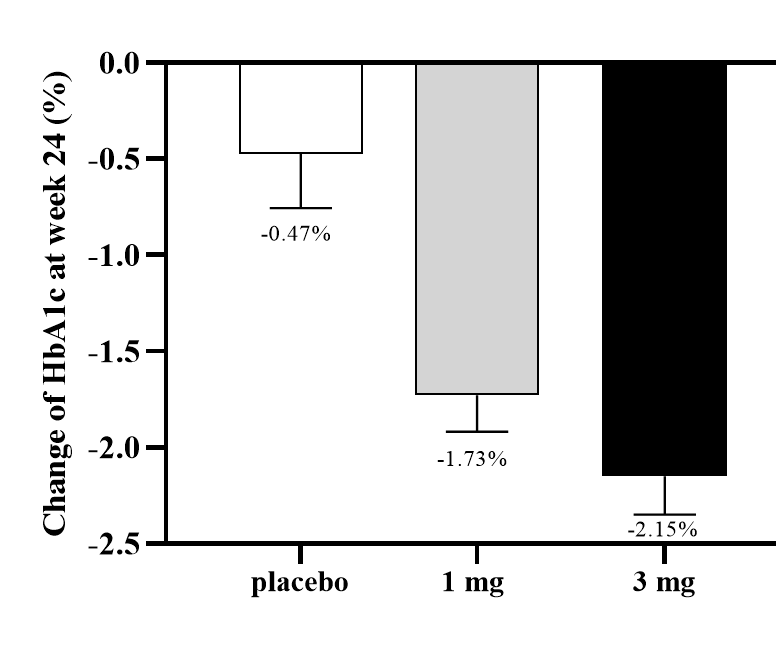
Image text and data — YN011-301 figure: HbA1c change at 24 weeks
From left to right, the bars represent placebo, efsubaglutide alfa 1 mg and 3 mg. HbA1c changes from baseline at week 24 are −0.47, −1.73 and −2.15 percentage points. The vertical axis runs from 0 to −2.5. Error bars are shown without an in-image definition.
The 24-week safety data showed favourable safety and tolerability across the tested doses, with mild adverse reactions. Adverse events among participants, including those receiving placebo, were mainly gastrointestinal symptoms such as diarrhoea, nausea and vomiting. These were grade 1–2 and mostly transient. Hypoglycaemia was uncommon, and no severe hypoglycaemic events occurred.
YN011-302: Combination treatment for type 2 diabetes inadequately controlled by metformin. Study 302 was a multicentre, randomised, double-blind, placebo-controlled Phase III study adding efsubaglutide alfa injection to metformin in people with inadequate glycaemic control on metformin. The study was designed to last 52 weeks, comprising an initial 24-week double-blind, placebo-controlled period for primary efficacy and safety assessment, followed by 28 weeks of open-label efsubaglutide alfa for continued safety observation. Efficacy and safety analyses were performed after all participants completed the 24-week double-blind period. The study was led by Professor Weiping Jia of Shanghai Sixth People's Hospital, affiliated with Shanghai Jiao Tong University School of Medicine.
Adding efsubaglutide alfa improved glucose control in participants inadequately controlled by metformin. After 24 weeks, participants receiving 3 mg once weekly with metformin had a mean HbA1c reduction of 1.81 percentage points from baseline, significantly greater than placebo (P<0.001). In the 3 mg group, 58% achieved HbA1c below 7%, significantly more than placebo (P<0.001). Fasting and postprandial glucose, fasting body weight and BMI also improved.
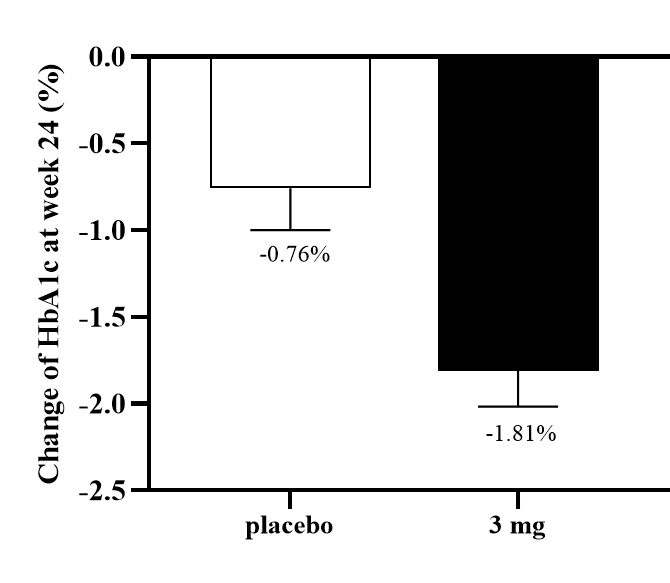
Image text and data — YN011-302 figure: HbA1c change at 24 weeks with background metformin
With background metformin, changes in HbA1c from baseline at week 24 are −0.76 percentage points for placebo and −1.81 for efsubaglutide alfa 3 mg. The vertical axis runs from 0 to −2.5, and error bars are not defined within the image. These exact labels differ from the rounded figures used in other conference slides.
The 24-week safety findings showed favourable safety and tolerability across tested doses and mild adverse reactions. Adverse events, including those in the placebo group, were mainly gastrointestinal symptoms such as diarrhoea, nausea and vomiting; all were grade 1–2 and mostly transient. Hypoglycaemia was uncommon.
At the time of this announcement, the two Phase III studies in type 2 diabetes were expected to finish in the second quarter of 2023, with principal clinical results expected in the third quarter of 2023.
Professor Dalong Zhu, Chair of the Chinese Diabetes Society, principal investigator of Study 301 and a physician at Nanjing Drum Tower Hospital, affiliated with Nanjing University Medical School, said: “As lifestyles change, the prevalence of type 2 diabetes in China is rising year by year, and more patients also have other metabolic diseases. This seriously affects their quality of life and health and creates substantial unmet clinical needs. It is therefore essential to provide safe, effective, accessible and affordable innovative medicines. I am delighted to see the very positive Phase III results for efsubaglutide alfa in people with type 2 diabetes inadequately controlled by diet and exercise. Once approved, it will benefit a broad population of patients.”
Professor Weiping Jia, a member of the Chinese Academy of Engineering, former Chair of the Chinese Diabetes Society, principal investigator of Study 302 and a physician at Shanghai Sixth People’s Hospital, affiliated with Shanghai Jiao Tong University School of Medicine, said: “Efsubaglutide alfa showed excellent glucose- and weight-lowering effects during the 24-week double-blind period in Chinese patients with type 2 diabetes inadequately controlled by metformin. Type 2 diabetes is a progressive disease, and most patients generally need combination treatment to achieve their glucose targets. Efsubaglutide alfa provides a new treatment option for these patients. I was deeply impressed by Innogen’s rigorous approach to research and consistently efficient execution in Study 302. I look forward to continuing our collaboration to explore efsubaglutide alfa’s potential in other metabolic diseases, such as obesity and non-alcoholic fatty liver disease, for the benefit of patients.”
“We are very excited about the Phase III results for efsubaglutide alfa. Once marketed, it has the potential to become the first domestically developed human-derived long-acting GLP-1 receptor agonist with independently owned intellectual property, and to be best in class,” said Dr Qinghua Wang, Innogen’s Founder, Chairman and CEO. “Innogen is committed to becoming a global leader in biopharmaceuticals for diabetes and metabolic diseases, providing best-in-class and first-in-class medicines to patients worldwide. We are applying to conduct several clinical studies in China and the United States to explore new uses for efsubaglutide alfa in other metabolic diseases and related areas.”
Development wording in the source versions
In the company’s original English version, Professor Weiping Jia specifically names NASH (nonalcoholic steatohepatitis) as a liver indication for further exploration and describes efsubaglutide alfa as a potential new treatment option. The Chinese source uses the broader term nonalcoholic fatty liver disease. Professor Qinghua Wang’s closing remarks refer to initiating studies in China and the United States in the English source, while the Chinese source refers to applying to conduct them. These source-version differences do not establish that an application had already progressed to an active trial.