
Medicine naming in the source
The Chinese source uses the spelling “依苏帕鲁肽α.” The current generic name is “依苏帕格鲁肽α” (efsubaglutide alfa), formerly “苏帕鲁肽” (supaglutide). The Chinese article retains its original spelling; this English translation uses the current generic name.
Original report · translated from Chinese
The Chinese Diabetes Society (CDS) held its 25th National Academic Conference in Wuhan on 22–25 November. Results from several GLP-1 clinical studies were disclosed, bringing new evidence and treatment ideas to diabetes care. Targeted medicines have become an active area of diabetes development, with multiple studies identifying GLP-1 as a breakthrough target following insulin. Efsubaglutide alfa, described as China’s first internally developed, next-generation humanised ultra-long-acting GLP-1 receptor agonist, was being developed in metabolic diseases including type 2 diabetes, obesity and non-alcoholic steatohepatitis (NASH). At the conference’s ‘New Evidence in Chinese Diabetes Research’ session on 24 November, Academician Weiping Jia presented the results of two major Phase III studies for the first time at CDS. The article reports that these clinical findings drew considerable attention.
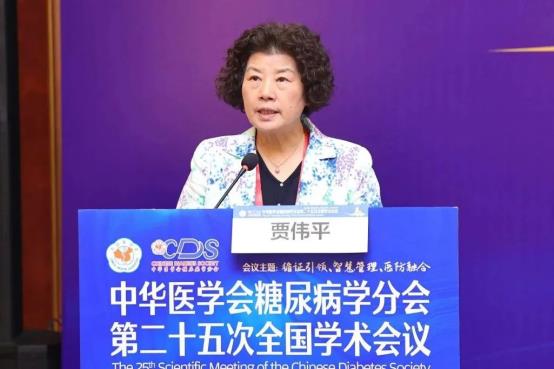
Image text and data — 25th National Academic Conference of the Chinese Diabetes Society
Academician Weiping Jia is pictured speaking at the lectern of the 25th National Academic Conference of the Chinese Diabetes Society, the CDS 2023 meeting described in the article.
Background
01
Innogen’s efsubaglutide alfa is a next-generation human ultra-long-acting GLP-1 receptor agonist intended for weekly subcutaneous administration to treat diabetes and metabolic disease.
02
Two Phase III diabetes studies had been completed: one led by Professor Dalong Zhu assessing monotherapy in people whose type 2 diabetes remained inadequately controlled after diet and exercise intervention, and another led by Professor Weiping Jia assessing efsubaglutide alfa with metformin in people inadequately controlled on metformin. More than 110 research centres and over 1,100 patients with type 2 diabetes participated across the two studies.
03
Development programs were underway in metabolic diseases including type 2 diabetes, obesity and NASH.
Glucose lowering with efsubaglutide alfa: HbA1c reductions of up to 2.2 percentage points as monotherapy and 1.8 points with metformin
According to Academician Jia, efsubaglutide alfa showed substantial glucose lowering both alone and with metformin. In the Phase III monotherapy study SUPER-1 (NCT04994288), participants received 1 mg, 3 mg or placebo. After 24 weeks, HbA1c in the 3 mg group fell by 2.2 percentage points from baseline, significantly more than with placebo (P<0.001), and nearly five times the placebo reduction of 0.47 percentage points.
In the Phase III combination study SUPER-2 (NCT04998032), participants inadequately controlled on metformin were randomised under double-blind conditions to weekly efsubaglutide alfa 3 mg or placebo, both added to metformin. At week 24, HbA1c in the efsubaglutide alfa group had fallen by 1.8 percentage points from baseline. The difference versus placebo was statistically and clinically significant (P<0.001).
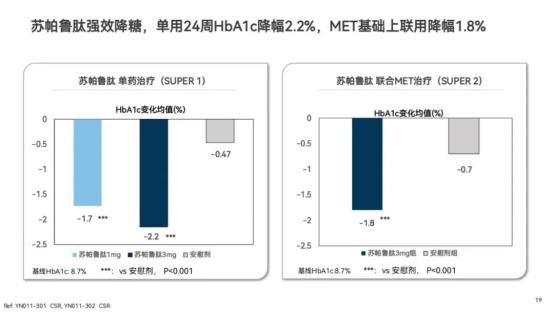
Image text and data — 2023 conference slide: HbA1c change at 24 weeks
The slide uses the former drug name supaglutide. In SUPER 1 monotherapy, the plotted changes in HbA1c from baseline are approximately −1.7 percentage points with 1 mg, −2.2 with 3 mg and −0.47 with placebo. Baseline HbA1c is shown as 8.7%; both active groups are marked P<0.001 versus placebo.
SUPER 2 adds treatment to metformin. The plotted HbA1c changes are approximately −1.8 percentage points with supaglutide 3 mg and −0.7 with placebo. Baseline HbA1c is shown as 8.7%, with P<0.001 for active treatment versus placebo.
These are rounded historical values from the conference slide. The two trials studied different treatment settings and populations. Both controls were placebo; the graphs do not establish superiority over another active medicine.
Rapid onset without dose titration: approximately one percentage point lower HbA1c after four weeks
Both monotherapy and combination treatment showed rapid effects, with HbA1c falling by approximately one percentage point after four weeks. In SUPER-1, reductions at week four were 1.1 percentage points with efsubaglutide alfa 3 mg and 0.3 with placebo. In SUPER-2, they were 0.9 points with efsubaglutide alfa 3 mg plus metformin and 0.4 with placebo plus metformin. Earlier research suggests that earlier glucose improvement may help reduce all-cause mortality and myocardial infarction risk in people with diabetes. Early intensive glucose-lowering strategies are therefore widely used, and the article identifies these findings as a useful basis for further clinical research and practice.
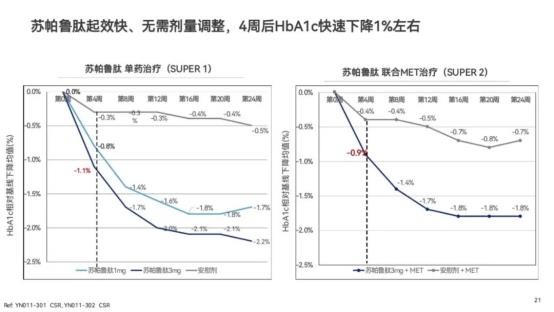
Image text and data — 2023 conference slide: HbA1c trajectories through week 24
The horizontal axis marks weeks 0, 4, 8, 12, 16, 20 and 24; the vertical axis shows HbA1c change from baseline. In the left-hand SUPER 1 monotherapy graph, light blue represents supaglutide 1 mg, dark blue 3 mg and grey placebo. In the right-hand SUPER 2 graph, blue represents supaglutide 3 mg plus metformin and grey placebo plus metformin.
At week 4, the 3 mg monotherapy group shows an approximately 1.1-percentage-point reduction and placebo a 0.3-point reduction. With metformin, the corresponding reductions are approximately 0.9 and 0.4 points. Reductions in the active-treatment groups then increase and persist through week 24. At week 24, the left graph shows reductions of approximately 1.7, 2.2 and 0.5 points for 1 mg, 3 mg and placebo; the right graph shows approximately 1.8 and 0.7 points.
The original slide describes rapid onset without dose adjustment. This is the wording of the historical 2023 conference material; approved product information governs dosing.
Glucose control, weight reduction and metabolic improvement: potential for broader patient populations
The article describes HbA1c ≤7% as the current gold standard for glucose control. In SUPER-1, 68% of participants receiving 3 mg monotherapy achieved HbA1c <7%, significantly more than the 15% with placebo. In SUPER-2, nearly 60% receiving efsubaglutide alfa 3 mg with metformin achieved HbA1c <7%, compared with 11% receiving placebo.
Fasting and post-meal glucose results were also reported. At week 24, fasting glucose fell by 2.5 mmol/L from baseline with 3 mg monotherapy in SUPER-1 and by 2.4 mmol/L with efsubaglutide alfa 3 mg plus metformin in SUPER-2, both significantly more than placebo (P<0.001). Two-hour post-meal glucose fell by 4–5 mmol/L with monotherapy or combination treatment, again significantly more than placebo (P<0.001).
For metabolic control, the article reports improved glucose tolerance, increased meal-stimulated insulin and C-peptide secretion, and improved β-cell function. Fifty-two-week safety data from the two Phase III studies indicated good safety and tolerability, with no level 2 or higher hypoglycaemia. The most common adverse reactions were gastrointestinal, mostly mild or moderate and transient.
In SUPER-2, body weight fell by 3.8% from baseline at week 24 in the efsubaglutide alfa 3 mg plus metformin group, significantly more than placebo (P<0.001). A preclinical study¹ reported significant weight reduction, reductions in white and visceral fat, maintenance of brown fat and muscle mass, and improvement in fatty liver, suggesting the potential to reduce fat while preserving muscle.
The article concludes that efsubaglutide alfa showed strong effects on glucose and metabolic control, alone or with metformin, and links these results to its pharmaceutical properties. It is a fusion protein in which GLP-1 is covalently linked to a human IgG2 Fc fragment through the immunoglobulin’s natural hinge region using genetic engineering. The article describes an optimised manufacturing process and a longer mean half-life of 204 hours compared with other long-acting GLP-1RAs.
Diabetes is a chronic metabolic disease that substantially affects public health. At the time of this report, China had more than 140 million people with diabetes, with a considerable economic burden. The NMPA’s Center for Drug Evaluation had accepted efsubaglutide alfa’s marketing application. If approved, the article anticipated that it could become China’s first next-generation humanised ultra-long-acting GLP-1 receptor agonist with independently owned intellectual property, offering a convenient treatment without dose titration. Innogen was also developing obesity and NASH indications to address additional metabolic diseases.

Image text and data — Group photograph at CDS 2023
Conference participants are pictured in front of signage for the 25th National Academic Conference of the Chinese Diabetes Society. The signage gives the dates 22–25 November 2023 and the location Wuhan, Hubei.
About Innogen
Innogen is a science-driven biopharmaceutical company seeking to provide innovative, accessible, affordable and high-quality medicines for people with metabolic diseases. It has multiple internally developed programs for indications including diabetes, obesity and NASH, with global patents, and plans to expand research, development and commercial activity internationally.