
Original report · translated from Chinese
Introduction
The 2024 Peking University Diabetes Forum took place in Beijing with a focus on cardiovascular, renal and metabolic health. At a May 18 session chaired by Professor Tianpei Hong, President-elect of the Chinese Medical Doctor Association's endocrinology and metabolism branch and Vice Chair of the Chinese Society of Endocrinology, Professor Qinghua Wang of Huashan Hospital, Fudan University, presented 'Obesity and the Three Highs: A New Treatment Option—A Detailed Review of Phase III Results for Efsubaglutide Alfa.' He examined the multiple potential benefits of long-acting GLP-1RAs in diabetes and metabolic disease. This report presents the main points of the session to inform weight-management practice in China.
An urgent need for weight management and the perspective offered by long-acting GLP-1RAs
Obesity has become a major health challenge in China. Over the past four decades its prevalence has risen sharply: approximately 34.3% of adults have overweight and 16.4% have obesity; the corresponding figures among adolescents are 11.1% and 7.9%. China has the world's largest number of people with obesity. Given rapid socioeconomic development, the article argues that this upward trend is unlikely to reverse soon.
Compared with Western populations, abdominal or central obesity is particularly common in China. The article attributes this to a tendency for fat to accumulate beneath the skin of the abdomen and around or within organs such as the liver, pancreas and gastrointestinal tract. It cites adult abdominal-obesity thresholds of a waist circumference above 90 cm in men or above 85 cm in women. Research suggests abdominal obesity raises the risk of fatty liver, insulin resistance, type 2 diabetes and atherosclerosis.
Weight loss, conversely, can offer multiple benefits. The article cites a study published the previous year by Harvard University researchers linking weight loss with slower brain ageing: after 18 months of intervention, a 1% reduction in weight was associated with a brain age 8.9 months younger [1]. It also cites the 2023 ADA guidelines, which state that people with type 2 diabetes and overweight or obesity can benefit from moderate or greater weight loss; a reduction of approximately 3%–7% of baseline weight can improve glycaemia and other cardiovascular risk factors [2].
Obesity is often not treated as a distinct disease requiring clinical management, so interventions tend to emphasise lifestyle changes, including diet, physical activity and less sedentary time. These measures can be difficult to sustain and may have limited effects in practice. New strategies are therefore needed to prevent and manage obesity more effectively.
The emergence of GLP-1RAs has changed glucose and weight management worldwide. Their mechanism can improve glucose, lipid and blood-pressure measures and reduce weight. Compared with bariatric surgery, GLP-1RA treatment avoids the operative and surgical-complication risks while offering glucose and weight effects, showing potential as a medical treatment for obesity. Based on clinical evidence, a long-acting GLP-1RA received obesity approval in the United States in 2021 and in Europe in 2022. Several long-acting GLP-1RAs are now being developed for weight management, including promising original Chinese medicines.
Weight-loss findings in people without diabetes
Weight observations from a drug-interaction study
These four-week weight observations came from a single-centre, open-label, fixed-sequence study in 31 participants without diabetes. The study evaluated how efsubaglutide alfa affected the pharmacokinetics of digoxin or metformin; eligible BMI was 20–28 kg/m². The weight observations alone do not establish efficacy as an obesity treatment.

The meeting presented efsubaglutide alfa weight-loss data in people without diabetes for the first time. Group A, receiving efsubaglutide alfa with digoxin, and Group B, receiving it with metformin, had respective weight reductions of 5.4% and 7.0% from baseline; their baseline BMIs were 24.42 and 24.17 kg/m². Mean weight loss was reported as 8 jin, equivalent to 4 kg. Across participants, 71% lost at least 5% of their body weight, rising to 80% in the metformin combination group. The report interpreted these findings as evidence of a clear weight effect.
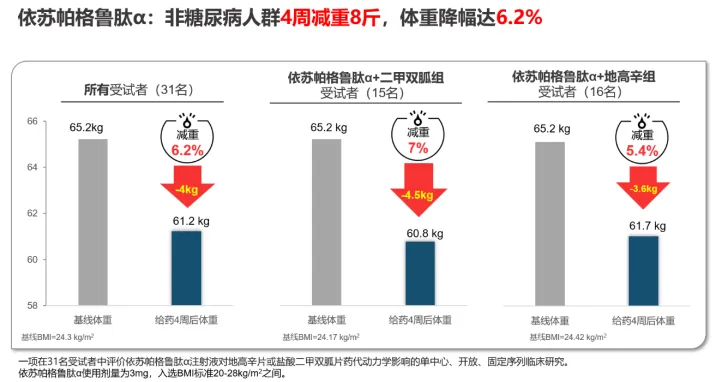
Image text and data — 2024 forum figure: four-week weight change in participants without diabetes
The headline describes an 8-jin (4 kg), 6.2% weight reduction over four weeks in participants without diabetes. Across all 31 participants, the plotted weights are 65.2 kg at baseline and 61.2 kg at week 4, with a labelled reduction of 4 kg (6.2%). Baseline BMI is 24.3 kg/m².
For the 15 participants receiving efsubaglutide alfa plus metformin, weights are 65.2 kg and 60.8 kg, with a labelled reduction of 4.5 kg (7%) and baseline BMI 24.17 kg/m². For the 16 receiving efsubaglutide alfa plus digoxin, weights are 65.2 kg and 61.7 kg, with a labelled reduction of 3.6 kg (5.4%) and baseline BMI 24.42 kg/m².
The footnote identifies a single-centre, open-label, fixed-sequence study in 31 participants evaluating the effects of efsubaglutide alfa injection on the pharmacokinetics of digoxin tablets or metformin hydrochloride tablets. Efsubaglutide alfa was given at 3 mg; eligible BMI was 20–28 kg/m². Values are transcribed from the figure's labels without recalculation.
This drug-interaction study was not a controlled trial designed to establish weight-loss efficacy.
Alongside these weight findings, efsubaglutide alfa, an original Chinese medicine, had already shown several potential advantages in glucose-lowering treatment.
1. Substantial glucose lowering with rapid onset. Efsubaglutide alfa showed strong glucose-lowering effects both alone and with metformin. After 24 weeks, HbA1c fell by up to 2.2 percentage points with 3 mg monotherapy and by up to 1.8 percentage points with metformin. A reduction of approximately 1 percentage point was evident after four weeks.
2. A distinctive molecular design. Innogen's researchers used recombinant-protein genetic engineering to join GLP-1 to the human IgG2 Fc segment through the natural immunoglobulin hinge, creating a dimeric fusion protein. The article states that the hinge increases receptor affinity and binding, while the IgG2 Fc segment raises molecular weight and reduces renal clearance. Changes to the GLP-1 sequence also reduce degradation by DPP-4. Together, these features slow clearance and extend the half-life to 204 hours, giving the molecule potential for once-weekly or once-every-two-weeks administration and greater treatment convenience.
3. Favourable tolerability and safety. According to the two Phase III studies, efsubaglutide alfa was well tolerated over longer treatment, with a very low risk of hypoglycaemia and lower reported rates of adverse events such as nausea and vomiting that can lead patients to stop treatment.
4. Convenient administration without dose titration. The report describes a single-step automatic injection and the potential for injections every one to two weeks, which could support adherence.
The science behind the name efsubaglutide alfa
The Chinese Pharmacopoeia Commission named the product in accordance with the biological-product naming principles in Volume III of the 2020 Chinese Pharmacopoeia and relevant WHO rules. The source explains the Chinese name as follows: 'Yi' indicates the human immunoglobulin Fc domain; 'Supa' identifies the compound developed by Innogen's researchers; 'glutide' denotes a GLP-1 analogue; and 'α' denotes a glycosylated compound, protein or peptide. The naming reflects the complexity and precision of innovative-drug development, compliance with international naming rules, and development standards aligned with international practice.
Conclusion
Professor Tianpei Hong praised Professor Qinghua Wang's decade of sustained research and described efsubaglutide alfa as an important example of Chinese scientific research translated into medicine. In light of unmet glucose- and weight-management needs in China, he said its clinical findings gave it the potential to become one of the strongest weekly GLP-1 options, particularly as a high-quality and convenient choice for people with both diabetes and obesity.
Professor Linong Ji reflected on more than 40 years of clinical diabetes practice. He said that although effective treatments had long been sought, the emergence of GLP-1 receptor agonists, especially weekly long-acting formulations, had brought important breakthroughs in the preceding decade. He described effects on glucose, weight and multiple organs, including cardiovascular and renal protection, but noted that uptake in China still had substantial room to grow. He called for stronger clinical education and greater policy support for Chinese innovators to encourage competition, broaden patient benefit and improve quality of life. Professor Hong then used May 20, a date associated with expressing affection in China, to encourage people to care for themselves and others by tackling diabetes and obesity and communicating the importance of healthy living.

References
1. Levakov G, et al. The effect of weight loss following 18 months of lifestyle intervention on brain age assessed with resting-state functional connectivity. Elife. 2023 Apr 6;12:e83604.
2. Diabetes Care. 2023;46(Suppl. 1):S5–S9.
The original English explanation of the medicine’s name
The company’s original English version also explains the English name component by component: “Ef” denotes the human immunoglobulin Fc domain; “suba” identifies the compound developed by Innogen’s research team; “glutide” denotes a GLP-1 analog; and “Alfa” denotes a glycosylated compound, protein or peptide. This is the naming explanation given in the company’s article.