
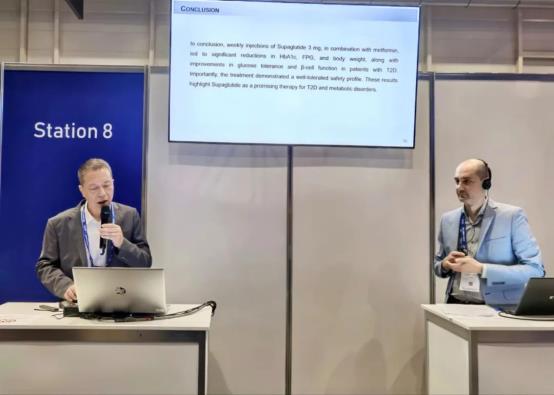
The 59th Annual Meeting of the European Association for the Study of Diabetes (EASD) took place in Hamburg, Germany, in October, presenting results from several GLP-1 clinical studies and new information and treatment approaches for diabetes. Recent clinical research has established GLP-1 as a breakthrough target following insulin, making targeted therapies a focus of diabetes R&D. Supaglutide is China's first independently developed, humanized, long-acting GLP-1 receptor agonist. Its inventor, Innogen founder and chairman Professor Qinghua Wang, was invited to deliver an oral presentation on 3 October, reporting results from two Phase III studies. The medicine's strong clinical results attracted considerable attention at the meeting.
Background
1
Innogen's supaglutide is a human-derived, long-acting GLP-1 receptor agonist intended for once-weekly subcutaneous administration to treat diabetes and metabolic disease.
2
Development programs cover metabolic diseases including type 2 diabetes, obesity and NASH.
3
Two Phase III diabetes studies have been completed: monotherapy in people with type 2 diabetes inadequately controlled after diet and exercise, and add-on treatment in people inadequately controlled on metformin. Together, the studies involved more than 110 research centers and over 1,100 patients with type 2 diabetes.
Rapid onset with supaglutide monotherapy
HbA1c reduction of up to 2.15 percentage points
In the Phase III monotherapy study in patients with type 2 diabetes (NCT04994288), participants were randomized 2:2:1 to supaglutide 1 mg, supaglutide 3 mg or placebo. After 24 weeks, HbA1c fell by 1.73 and 2.15 percentage points from baseline in the 1 mg and 3 mg groups, respectively, significantly more than with placebo (P<0.001).
Supaglutide monotherapy acted rapidly: HbA1c in the 3 mg group had fallen by 1.1 percentage points by week 4.
In the supaglutide 1 mg group, 56% of participants achieved HbA1c <7%. In the 3 mg group, 68% achieved HbA1c <7%, significantly more than the 15% receiving placebo. At week 24, fasting plasma glucose (FPG) fell by 2.04 mmol/L and 2.49 mmol/L from baseline in the 1 mg and 3 mg groups, respectively, significantly more than with placebo (P<0.001).
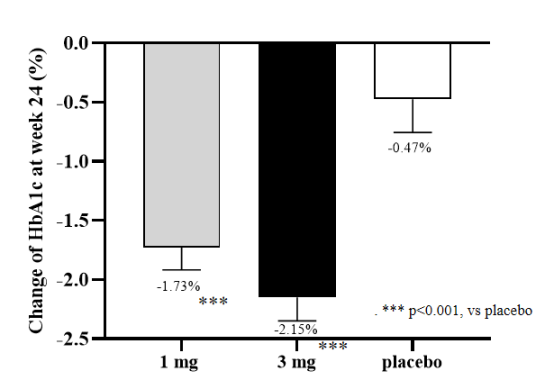
Image text and data — EASD 2023 figure: HbA1c change after 24 weeks of monotherapy
The vertical axis shows change in HbA1c from baseline at week 24. The 1 mg, 3 mg and placebo groups are labelled −1.73, −2.15 and −0.47 percentage points, respectively. Both active groups carry ***, defined as P<0.001 versus placebo. Error bars are drawn, but their statistical definition is not given within the image.
Supaglutide with metformin
Glucose lowering, weight reduction and metabolic control together
The Phase III study of supaglutide with metformin in type 2 diabetes (NCT04998032) randomized patients inadequately controlled on metformin under double-blind conditions to once-weekly supaglutide 3 mg or placebo, both added to metformin. At week 24, HbA1c fell by 1.8 percentage points from baseline in the supaglutide 3 mg group, with a statistically and clinically significant difference from placebo (P<0.001). In the supaglutide group, 58% of participants achieved HbA1c <7%, significantly more than with placebo (P<0.001).
Supaglutide significantly improved glucose tolerance, increased meal-stimulated insulin and C-peptide secretion and improved β-cell function. Fifty-two-week safety data from the two Phase III studies showed good safety and tolerability, with no severe hypoglycemia. Gastrointestinal symptoms were the most common adverse reactions and were mostly mild or moderate and transient.
Both as monotherapy and with metformin, supaglutide showed strong efficacy in blood-glucose improvement and metabolic control. These clinical results are supported by its pharmaceutical properties. Supaglutide is a fusion protein combining GLP-1 with the human immunoglobulin IgG2 Fc fragment. Genetic engineering covalently links GLP-1 to human IgG2 Fc through the natural hinge region of immunoglobulin. With an optimized process, supaglutide has a longer half-life than comparable long-acting GLP-1RAs, with a mean of 204 hours.
Diabetes is a chronic metabolic disease that seriously harms health. More than 140 million people in China have diabetes, imposing a substantial economic burden. The Center for Drug Evaluation (CDE) of the NMPA recently accepted supaglutide's new-drug application. If approved, it is expected to become China's first independently patented, humanized, long-acting GLP-1 receptor agonist, offering another treatment option and supporting progress in diabetes care in China. Innogen is also developing supaglutide for obesity and nonalcoholic steatohepatitis to benefit more patients with metabolic diseases.
About Innogen
Innogen is a science-driven biopharmaceutical company committed to innovative, accessible, affordable and high-quality medicines for people with metabolic diseases. Its pipeline includes programs for diabetes, obesity and nonalcoholic steatohepatitis. All are independently developed with global patents, and the company plans to establish global R&D and commercial operations.